
01 · Off-center load
Load one side of the carriage.
With a person aboard, check lateral play, wheel contact, rail alignment, sound, and glide at slow speed. Film the carriage and rail together from close range.
Studio owner's quality guide
Overall width and a bearing label can be useful specifications. Neither proves that a commercial reformer is more stable, smoother under load, easier to teach on, or better supported after purchase.
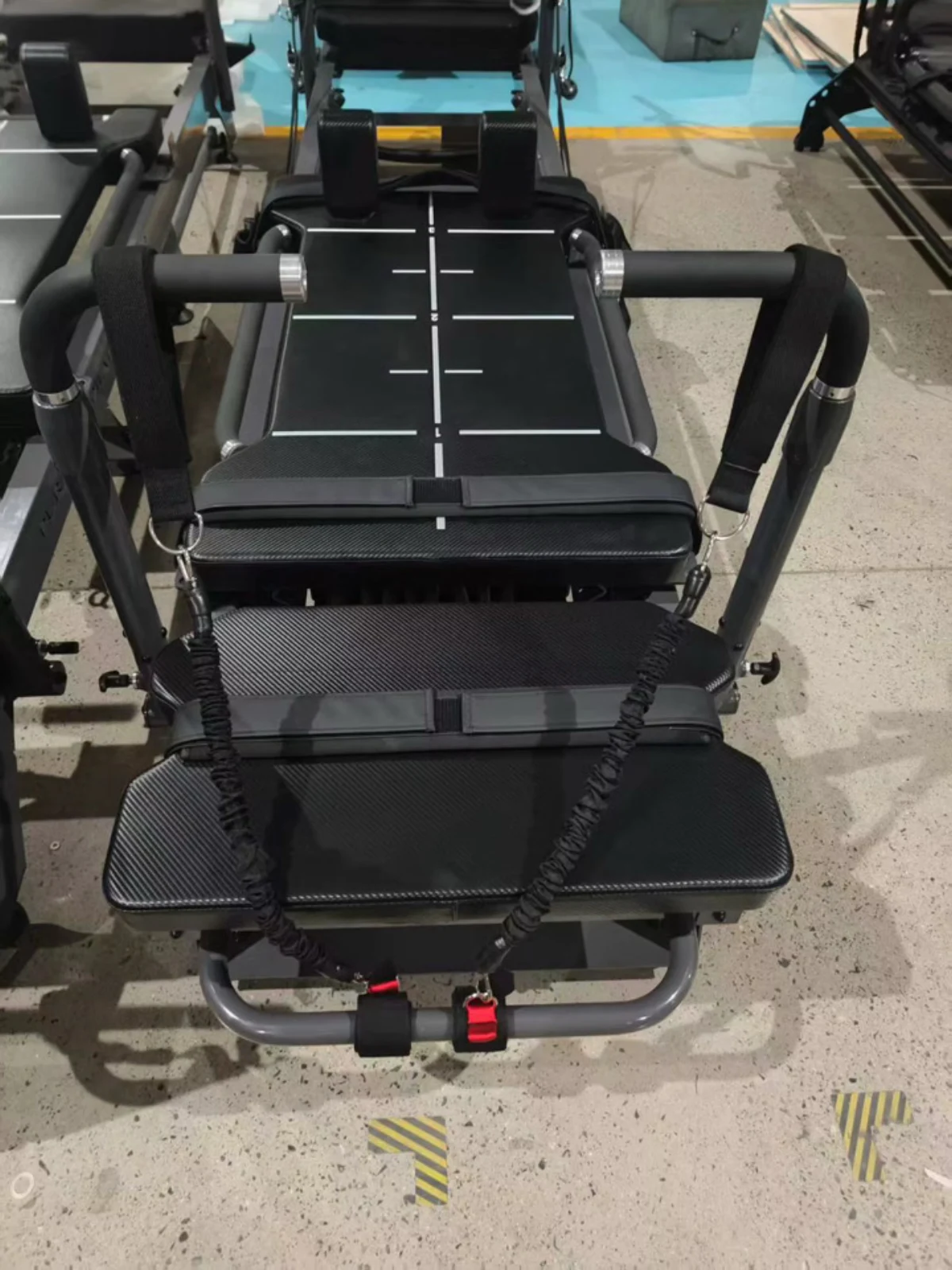
Sculptformer publishes a 126 × 33 inch overall machine size. Carriage One measures 128 × 26 inches. The 33-inch figure is an overall width—not evidence that every working surface is 33 inches wide. Overall width alone cannot establish stability, transition quality, or exercise suitability.
| Published envelope | Carriage One | Sculptformer |
|---|---|---|
| Overall dimensions | 128 × 26 in | 126 × 33 in |
| Raw machine footprint | About 23.1 sq ft | About 28.9 sq ft |
| What width proves | Room envelope only | Room envelope only |
Across ten machines, those published envelopes differ by about 58 square feet before circulation and operating clearances. Use the room plan and hands-on testing—not width alone—to choose.
Loaded demonstration protocol
Record the exact model, spring setting, user load, test date, sound, movement, and observations so a polished unloaded glide video cannot substitute for comparable evidence.
01 · Off-center load
With a person aboard, check lateral play, wheel contact, rail alignment, sound, and glide at slow speed. Film the carriage and rail together from close range.
02 · Working structure
Use loaded lunges, planks, presses, and strap work. Watch handle rigidity, platform movement, frame movement, working reach, and transition clearance.
03 · Repeated operation
Run repeated full carriage travel, then change from light to heavy configurations. Note sound, consistency, adjustment time, cleaning access, and anything that loosens or shifts.
ABEC grades bearing tolerances. Bearing specialists note that the grade does not specify other performance factors such as material quality, internal clearance, lubrication, torque, or noise. It also says nothing about the wheel, rail, alignment, loading, or serviceability of the finished reformer carriage.
No. Overall width is a room-planning dimension, not a quality grade. It does not establish the size of each working surface, frame rigidity, loaded carriage behavior, or how transitions feel. Compare the exact machine under load.
No. The published Sculptformer dimensions are 126 by 33 inches overall, while Carriage One is 128 by 26 inches overall. Those figures describe the machine envelopes. They do not prove that one machine is more stable, more substantial, or better for planks and lunges.
No. ABEC is a bearing-tolerance classification. It does not by itself specify material quality, internal clearance, lubrication, noise, wheel material, rail alignment, loaded carriage play, or the service life of the completed carriage assembly.
Carriage One is in commercial studio use today, and Carriage machines are used in daily classes. The Carriage Co. does not publish customer names, machine counts, or exact class volumes without permission, but a prospective buyer may ask the company to request a reference introduction.
Test lateral carriage play, glide under off-center load, handle and platform rigidity, spring consistency, transition reach, adjustment speed, noise, cleaning access, and the replacement-parts process. Also compare the written warranty, freight handoff, assembly, and current parts timing.
Carriage One publishes its price, overall and carriage dimensions, approximate machine weight, rated user load, frame and upholstery materials, included components, production range, delivery scope, maintenance routine, replacement-parts process, and 10 / 2 / 1 limited commercial warranty.